
If you run a spray booth—whether for automotive refinishing, industrial coating, or furniture finishing—you know that managing overspray is not just about keeping the workplace clean. It’s about compliance, cost control, and maintaining consistent finish quality. The heart of any dry paint mist collection system is the paint mist filter box or cartridge. But with so many options on the market, how do you pick the right one?
In this article, we’ll walk through the main types of paint mist filter boxes, trace their development over the past century, and share practical tips for selecting the best solution for your line. Whether you’re an engineer upgrading an existing booth or a buyer sourcing for a new project, this guide will help you make an informed decision.
Why Paint Mist Filtration Matters More Than Ever
Before diving into product types, let’s quickly recap why the humble filter box deserves serious attention:
Worker health: Paint overspray contains hazardous particulates and VOCs. Proper filtration protects operators and meets OSHA/NIOSH exposure limits.
Environmental compliance: Many regions now enforce strict limits on particulate emissions (PM10, PM2.5). A good filter box keeps your stack within legal bounds.
Equipment protection: Uncaptured paint dust can damage downstream fans, ductwork, and even ruin the finish on freshly painted parts when recirculated.
Operating cost: Frequent filter changes eat into profits. Choosing a high-capacity, long-life filter box reduces downtime and disposal costs.
Now let’s look at what’s available.
Classification of Paint Mist Filter Boxes by Separation Principle
Paint mist filter boxes can be grouped by how they physically separate wet, sticky droplets from the airstream. Here are the five dominant principles used today:
1. Inertial Impaction / Baffle Type
These rely on sudden changes in airflow direction. Heavy paint particles cannot follow the sharp turns and slam into baffles or labyrinth walls where they stick.
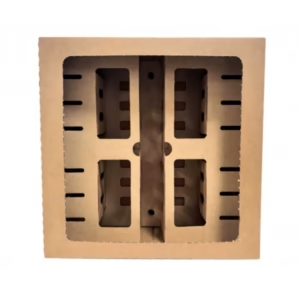
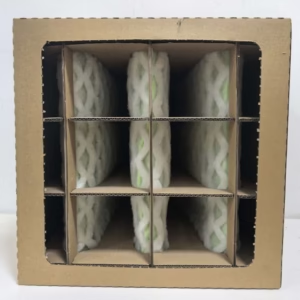
Typical products: Maze-type cardboard boxes, multi-chamber paper cartridges (e.g., Paint Cube style).
Best for: Pre-filtration of large droplets (>20 µm) before finer stages. Often used as first-stage in two-stage systems.
2. Interception / Fiber Media
The airstream passes through a mat of glass fiber, polyester, or synthetic fibers. Particles collide with fibers and adhere.
Typical products: Paint arrestor pads (glass fiber blankets), pocket bags, pleated panels.
Best for: Medium-efficiency filtration (M5–F7 class) in smaller booths or as second-stage after baffles.
3. Deep-Bed / Honeycomb Structure
Three-dimensional cellular structures (often made of treated paper or synthetic material) create tortuous paths. Paint mist penetrates deep into the matrix, allowing high loading capacity.
Typical products: Honeycomb cellulose filter boxes, DPA (dense particle accumulator) synthetic cartridges.
Best for: Continuous robotic painting lines with high overspray volume; excellent for both solvent-borne and waterborne paints.
4. Venturi / Cyclonic Paper Separators
Air is accelerated through narrow slots or cones (venturi effect), causing droplets to spin out centrifugally and collect on paper surfaces.
Typical products: Disposable paper venturi separators, accordion-style paper filters.
Best for: Small to medium-sized dry booths where low initial cost is important.
5. Electrostatic Precipitation
High-voltage electrodes charge paint particles, which then migrate to grounded collection plates.
Typical products: Electrostatic precipitator modules (less common in portable filter boxes; mostly integrated into large systems).
Best for: Very fine aerosol removal (<1 µm) in high-end automotive lines.
Classification by Housing Design
Beyond the separation principle, the physical form of the filter box matters for installation and maintenance:
Drawer-style catch boxes: Slide into a housing frame; often use multiple baffle chambers inside. Easy to replace without tools.
Cartridge / cassette boxes: Rigid outer shell (cardboard or metal) containing folded media. Sealed against bypass. Common in modern dry booths.
Panel / pad frames: Simple rectangular frames holding fiber mats. Low cost but lower efficiency and shorter life.
Composite boxes: Combine a coarse pre-filter layer (e.g., glass fiber) with a fine final layer (e.g., activated carbon for odor/VOC control).
Materials Used in Paint Mist Filter Boxes
The choice of material directly affects performance, lifespan, and disposal method:
Material | Pros | Cons |
|---|---|---|
Glass fiber | Low cost, widely available | Fibers can shed; limited dust holding; not incinerable |
Treated paper / cellulose | Biodegradable, good stiffness for honeycomb shapes | Limited moisture resistance; can sag under heavy load |
Synthetic fibers (PP, PET) | High strength, self-supporting, fully incinerable | Higher upfront cost than paper |
DPA (dense particle accumulator) | 3D honeycomb structure; holds up to 27 kg/m²; 99.8% efficiency on ≥10 µm | Premium price; requires proper sizing |
Ceramic / mineral wool | Fireproof, used in lime-based dry scrubbers | Heavy; requires special handling |
The Historical Evolution of Paint Mist Filter Boxes
Understanding how we got here helps explain why certain designs dominate today.
1910s – Baffle Boards
The earliest “filters” were simple wooden or metal baffles placed in the exhaust path. They worked for very coarse overspray but clogged quickly and had no standard replacement schedule.
1950s – Water Wash Booths
Water curtains and scrubbers became popular because they could handle huge volumes of sticky paint without blinding. However, they introduced sludge treatment, chemical additives, and high energy costs for pumps and fans.
1963 – First Disposable Paper Separator
The invention of the disposable paper venturi separator was a breakthrough. It allowed small booths to go dry without water. This is still sold today under various brand names.
1980s – Glass Fiber Media Dominance
Needled glass fiber mats (often called “paint arrestors”) became the default choice for dry booths. They were cheap and easy to replace, but efficiency dropped rapidly as they loaded.
2005 – Lime-Based Dry Scrubbers
Dürr’s EcoDryScrubber used calcium hydroxide powder to encapsulate paint particles, making them non-sticky, then separated them with ceramic filter modules. This enabled closed-loop air recirculation, cutting energy use by up to 45%. However, it required a complex central system.
2010 – Electrostatic Dry Booths
High-voltage electrostatic precipitation was applied to paint mist, offering high efficiency on submicron particles. Still niche due to high capital cost.
2013 – Modular Cardboard Filter Boxes
The concept of a self-contained, replaceable cardboard box with internal baffles or honeycomb structure emerged. These could be swapped in minutes, eliminating messy media handling. This is the direct ancestor of most modern paint mist filter boxes.
2020s – DPA & Advanced Synthetic Media
Today, the frontier is DPA synthetic cartridges with 3D honeycomb cores that combine deep loading, high efficiency, and full incinerability. They are becoming the standard for high-production automotive and industrial lines.
Key Trends Driving Future Development
Looking ahead, several forces are shaping the next generation of paint mist filter boxes:
1. Dry-Only Systems Are Winning
Water wash booths are being phased out in many regions due to water scarcity, sludge disposal costs, and stricter wastewater regulations. Dry filter boxes are simpler, cheaper to operate, and produce solid waste that can often be incinerated for energy recovery.
2. Higher Dust-Holding Capacity
Customers demand longer service intervals. New honeycomb geometries and gradient-density media allow filter boxes to hold 3–5× more paint before reaching terminal pressure drop.
3. Smart Monitoring
Pressure sensors paired with IoT platforms now predict remaining filter life and send alerts when replacement is needed. Some systems even adjust fan speed automatically to maintain constant airflow.
4. Circular Economy & Incineration
Disposal regulations are tightening. Filter boxes made entirely of incinerable materials (paper, polypropylene, polyester) are preferred because they can be burned as fuel in cement kilns or waste-to-energy plants. DPA cartridges already achieve 100% incineration.
5. Integration with VOC Control
Stricter emission limits mean filter boxes are increasingly combined with activated carbon or zeolite rotors. Composite boxes that include a carbon layer are gaining traction for applications where both particulates and odors must be controlled.
How to Choose the Right Paint Mist Filter Box for Your Application
There is no universal “best” filter box. The right choice depends on these factors:
Paint type: Solvent-borne paints tend to be tacky and require filters with anti-wetting coatings. Waterborne paints are less sticky but may need higher efficiency to capture fine droplets.
Particle size distribution: If most overspray is >20 µm, a simple maze box may suffice. For fine atomization (robotic spray guns), you need a honeycomb or DPA cartridge that captures down to 5–10 µm.
Airflow rate: Filter boxes have a recommended face velocity (typically 1–2 m/s). Oversizing leads to poor capture; undersizing causes premature clogging.
Change-out frequency: High-volume lines should invest in high-capacity DPA boxes despite higher unit cost, because total cost per part painted is lower.
Fire safety: Many insurance companies require UL 94 V-0 rated materials for filter boxes in paint booths. Always verify fire retardancy certification.
Local regulations: Check whether your area allows landfilling of paint-laden filters or requires incineration. That will influence material choice.
Why Work with KunHai (khfilter.com) for Your Paint Mist Filter Needs?
At Kunshan Kunhai Clean Technology Co., Ltd., we don’t just sell filter boxes—we engineer filtration solutions for real-world spray booth challenges. Here’s what sets us apart:
Vertical integration: We produce over 70% of our raw materials in-house, including specialty mica paper and flame-retardant synthetic fibers. This gives us unmatched control over quality and lead time.
R&D capability: Our engineers have developed proprietary honeycomb and DPA formulations that maximize dust holding while maintaining low pressure drop.
Customization: Need a non-standard size, a specific fire rating, or a combination of coarse/fine layers in one box? We can design and deliver prototypes in days.
Global track record: Our filters are used in automotive OEMs, industrial coating lines, and wood finishing shops across Europe, Southeast Asia, and the Americas.
Final Thoughts
The paint mist filter box has come a long way from simple baffle boards to sophisticated, high-capacity synthetic cartridges. Understanding the types and their evolution helps you avoid costly mistakes—like choosing a glass fiber pad for a robotic line that needs a DPA cartridge, or installing a paper venturi where moisture is present.
As environmental regulations tighten and production speeds increase, the trend is clear: dry, modular, high-capacity filter boxes with smart monitoring will become the norm. Staying ahead of these trends ensures your spray booth operates efficiently, compliantly, and profitably.
Want to discuss which paint mist filter box fits your application? Contact our technical sales team at sales@khfilter.com or visit for product datasheets and free sample requests.
#keywords
paint mist filter box, dry paint mist filter, spray booth filter, DPA filter cartridge, honeycomb paint mist filter, venturi paint mist separator, paint arrestor pad, dry scrubber filter, OEM paint mist filter manufacturer, China paint mist filter factory.